GST Bill Book Printing in Mumbai: Format, Mandatory Fields & 2026 Pricing
Everything Mumbai shop owners need to print a GST-compliant bill book in 2026 — mandatory fields, page formats, NCR vs carbon paper, sizes, and current pricing from Mulund printers.
Every shop in Mumbai still runs on paper bills — kirana stores, sweet shops, mobile-repair counters, parlours, clinics, garages. Even after UPI killed cash, the bill book lives on, because GST law treats your invoice as a legal document. Get the format wrong and your CA spends hours fixing it at filing time.
This guide covers everything we’ve learned printing thousands of bill books for Mumbai shops — what GST requires on the page, how the duplicate-vs-triplicate decision actually impacts you, and what you should expect to pay in 2026.
What a GST-compliant bill book must contain
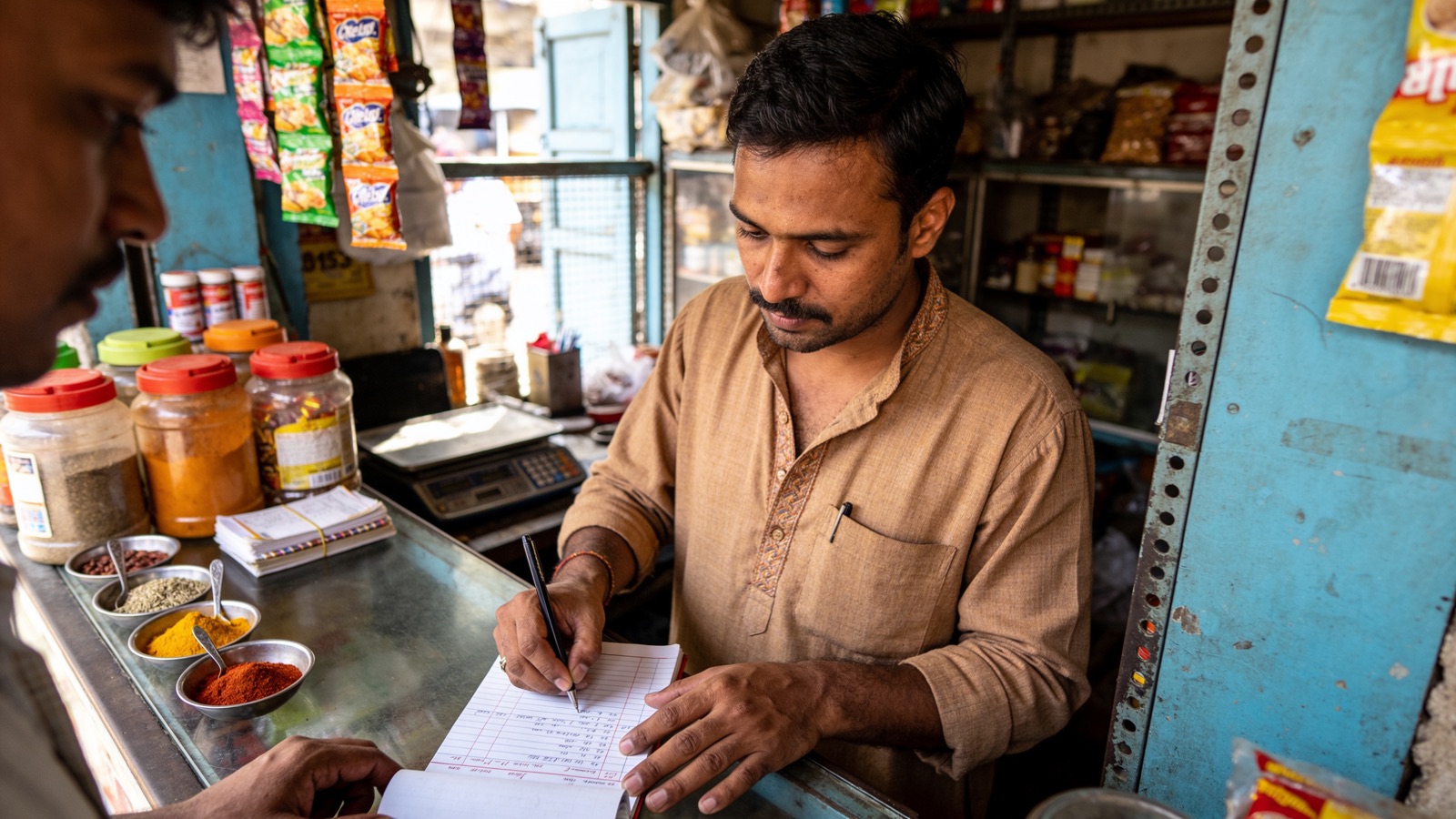
Under the CGST Rules, 2017 (Rule 46), a tax invoice issued by a registered business must carry these fields. Print them once on every page, leave space for the variables (item, quantity, amount).
- Supplier name, address, and GSTIN — usually pre-printed in the header
- Invoice number — sequential, unique, max 16 characters; reset annually (April 1) is allowed
- Date of issue — DD/MM/YYYY format
- Customer name and address — for B2B (over ₹50,000) include their GSTIN too
- HSN/SAC code — mandatory for businesses with annual turnover above ₹5 crore (4-digit), above ₹1.5 crore (2-digit recommended), below that optional
- Description of goods or services — itemised, with quantity and unit
- Total value of supply — before GST
- Rate and amount of tax — split into CGST + SGST (intra-state) or IGST (inter-state)
- Place of supply — important for inter-state transactions (different state code triggers IGST)
- Signature — physical signature or digital signature of supplier or authorised representative
Two extras most printers forget:
- “Original / Duplicate / Triplicate” mark on each copy — required by Rule 48
- Reverse charge declaration if applicable (small italic line at footer)
If you’re under the composition scheme, the invoice has fewer fields and must say “Composition taxable person, not eligible to collect tax on supplies” at the bottom.
Single, duplicate, or triplicate — pick the right copy structure
Single-page (no copy): for receipts where you don’t need a record. Cash memos at street counters, parking tickets, gate passes. Cheap, but if a dispute comes up you have nothing.
Duplicate (2 copies):
- Original (white) — handed to customer
- Duplicate (yellow or pink) — kept in book for your records
This is the standard for retail shops, restaurants, salons — anywhere the customer takes the bill home and you need a record. ~80% of bill books we print are duplicate.
Triplicate (3 copies):
- Original (white) — buyer’s copy
- Duplicate (yellow) — transporter’s copy (only required for goods movement)
- Triplicate (pink) — supplier’s record copy
Required if you’re moving goods inter-state or to a courier — needed under Rule 48(1)(b). For most retail businesses that don’t ship goods, duplicate is enough.
Quick test: if your customer takes the goods themselves at the counter, duplicate is fine. If you dispatch goods through a transporter, courier, or e-commerce delivery, you need triplicate.
Regular paper vs NCR carbonless — what’s the difference
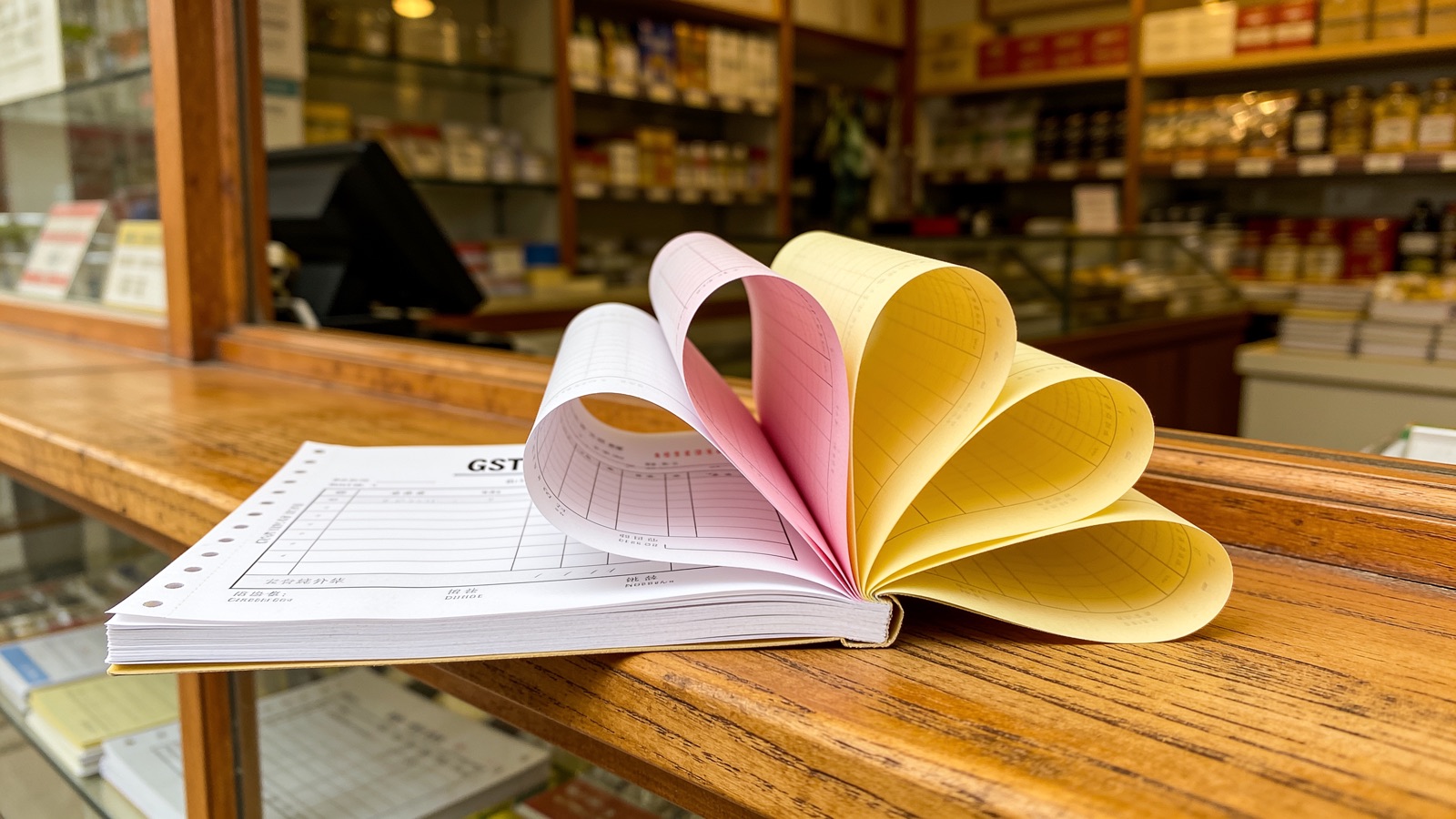
This is the biggest cost vs. convenience tradeoff in bill book printing.
Carbon-interleaved (cheap, messy)
Carbon paper is loosely placed between pages. You write on the top sheet, the carbon transfers ink to the copies below. Pros: cheapest. Cons: carbon falls out, smudges your hands, fades in 2 years, and looks unprofessional in a customer-facing bill.
NCR carbonless (recommended)
NCR = “No Carbon Required”. Each sheet is chemically coated so writing on the top sheet automatically appears on the copies below — no carbon paper between. Pros: clean hands, sharper copies, doesn’t smudge, lasts 5+ years. Cons: ~20–30% more expensive than carbon paper.
Our recommendation: unless your volume is huge (1,000+ books a year), always go NCR. The extra ₹15–25 per book is worth it the first time a customer can read their copy without a magnifying glass.
When to skip both
If you bill from a GST billing software (Tally, Vyapar, Marg, Zoho Books) and print on a thermal/dot-matrix printer, you don’t need a bill book — print on plain A4 or thermal rolls. We print plain numbered books for businesses transitioning between manual and software billing.
Standard sizes — what fits your counter
Mumbai shops use four standard sizes:
| Size | Dimensions | Best for |
|---|---|---|
| 1/3 A4 | ~99 × 297 mm | Pharmacies, kiranas, small counters |
| 1/4 A4 | ~105 × 148 mm | Cash memos, parking, dry cleaners |
| A5 | 148 × 210 mm | General retail, salons, cafés |
| A4 | 210 × 297 mm | Restaurants, B2B, anyone with ≥10 line items |
A5 is the most common — it fits inside any counter drawer, has space for 6–8 line items, and looks professional when handed to a customer. Go to A4 if you regularly bill multi-item orders (restaurants with 20-item bills, B2B suppliers with 15+ SKU invoices).
Page count per book
Standard options: 50, 100, 200 sets per book.
- 50 sets → small shops billing 5–10 customers/day, lasts 2–3 weeks per book
- 100 sets → medium shops, lasts 1–2 months
- 200 sets → high-volume cafés, restaurants, distributors, lasts a month or less
Order in pairs (book #1 + book #2 with continuous numbering 1–100, 101–200, etc.) so the next book picks up where the last ended.
Mumbai pricing benchmark (April 2026)
Real numbers from the Mulund / Bhandup / Vikhroli market — these are walk-in shop rates including GST, not the inflated quotes you’ll see on IndiaMART.
| Configuration | 50-set book | 100-set book | 200-set book |
|---|---|---|---|
| A5 duplicate, carbon-interleaved | ₹40–55 | ₹70–90 | ₹130–170 |
| A5 duplicate, NCR carbonless | ₹55–80 | ₹100–130 | ₹180–230 |
| A5 triplicate, NCR carbonless | ₹85–110 | ₹150–180 | ₹260–320 |
| A4 duplicate, NCR | ₹70–95 | ₹130–160 | ₹230–280 |
| A4 triplicate, NCR | ₹105–135 | ₹180–230 | ₹320–390 |
Volume discount: order 10 books at once and you’ll typically save 15–20% vs single-book pricing. We give a flat 25% discount above 25 books.
One-time setup cost: if you’re printing for the first time and don’t have a finalised design, expect a ₹250–500 design charge (one-time only — your future reorders skip this).
What pushes price up:
- 2-colour printing (logo in colour, body in black) — adds ₹8–15 per book
- Spiral binding instead of gum binding — adds ₹6–12 per book
- Heavier paper (80 GSM bond instead of 60 GSM offset) — adds ₹10–18 per book
- Custom numbering start (e.g. starting at 5,001) — usually free
How to order your bill book — what to send your printer
To skip the back-and-forth, send your printer this checklist on WhatsApp:
- Business name, address, GSTIN (exactly as you want it printed)
- Phone, email, website (optional but standard)
- HSN/SAC code if you want it pre-printed
- Bank details for B2B (account #, IFSC) — optional, useful if you accept NEFT
- Logo file — PNG, PDF, or AI; minimum 300 DPI; transparent background preferred
- Size: A5 / A4 / 1/3 A4 / 1/4 A4
- Copy structure: duplicate or triplicate
- Paper type: NCR carbonless or carbon-interleaved
- Page count: 50 / 100 / 200 sets
- Quantity of books: 1 / 5 / 10 / 25+
- Numbering: start from 1 or continue from your last book?
- Special fields: “Authorised Signatory” line, “Subject to Mumbai jurisdiction”, reverse-charge note, vehicle number row, etc.
We send a digital proof in 4–6 hours for approval. Once you sign off, the books arrive in 4–7 working days. Pickup from our Mulund West shop or paid delivery anywhere in Mumbai.
Reorder cycle — when to print your next batch
The mistake we see most: shops realise they’re out of bill books on a Tuesday afternoon, lose half a day’s billing, and have to handwrite on plain paper (which is technically a GST violation if not numbered sequentially).
Set a reorder trigger: when you reach the last 20% of pages in your current book, place the next order. With our 4–7 day turnaround, you’ll never run dry.
For high-volume businesses, we keep a standing order in our system — call us and we ship the next batch the same week.
FAQ
Is a handwritten bill on plain paper still a valid GST invoice? Only if it’s numbered sequentially, has all the fields under Rule 46, and you can prove the numbering hasn’t been altered. In practice, GST officers prefer to see a printed serial-numbered bill book. Don’t risk it.
Can I print a bill book in regional languages? Yes — we print in Marathi, Hindi, Gujarati alongside English. The amount, GSTIN, and tax fields should remain in English/Hindi as per government convention.
What’s a “bill of supply” and how is it different from a tax invoice? A bill of supply is for businesses under the composition scheme or selling exempt goods — they cannot charge GST. The format is similar but the document is titled “Bill of Supply” instead of “Tax Invoice”, and there’s no tax breakup. We print both formats.
Do I need a separate bill book for cash memo vs invoice? Recommended for clarity. A cash memo is a simplified receipt for B2C retail — no GSTIN field needed for the customer. A tax invoice carries the full GST format. Many shops keep both: cash memo book at the counter, tax invoice book for B2B customers asking for GST.
What about e-invoicing — do I still need a bill book? E-invoicing is mandatory for businesses with turnover above ₹5 crore (as of April 2026). If you’re below that threshold, paper bill books are still standard. Even above, many businesses keep a backup paper book for offline use.
Can I print the bill book myself on a laser printer? Yes for low volume, but: you need pre-perforated multi-part NCR paper (hard to source in small quantity), a sequentially-incrementing macro in your billing template, and a way to bind the pages. For most shops, ordering printed books is cheaper and looks more professional.
Need a bill book printed?
We print bill books for hundreds of Mumbai shops every month — pharmacies, restaurants, garages, salons, hospitals, B2B suppliers, distributors. Send us your details on WhatsApp and we’ll send a price + proof within 4 hours.
For more on business stationery, see our full Business Printing services guide — covers visiting cards, letterheads, envelopes, rubber stamps, and more.
Last updated: April 2026. GST rules and pricing reflect current regulations under CGST Rules 2017. For specific tax advice, consult your CA.